


 Back to Blog
India as a Recruitment Country: Why Germany Can Benefit from Indian Nursing Professionals
India as a Strategic Recruitment Country in the CWC Program
The shortage of skilled healthcare professionals is one of the biggest challenges of the coming years. According to estimates by the World Health Organization (WHO), around four million nursing professionals will be missing worldwide by 2030. At the same time, the demand for qualified staff continues to grow due to demographic change and the increasing complexity of healthcare.
Germany is no exception. Hospitals, senior care facilities and rehabilitation clinics are increasingly faced with the challenge of filling vacancies in a sustainable and long-term way. International recruitment has therefore become an important part of modern workforce strategies.
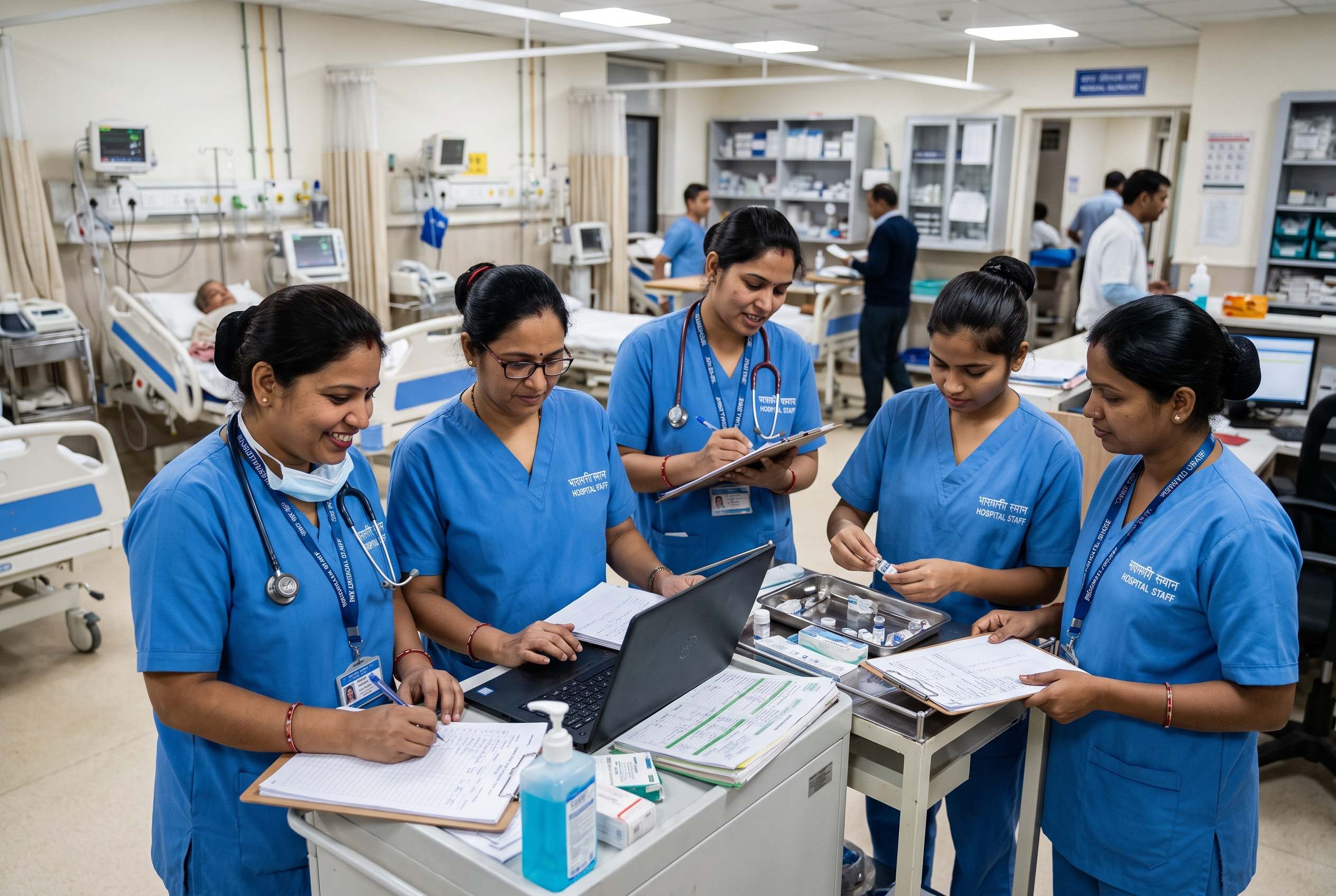
In this context, India plays a particularly important role. The country trains more nursing professionals every year than any other country in the world and has decades of experience in the international placement of healthcare professionals. Many Indian nursing professionals consciously choose an international career and prepare specifically for the requirements of their destination country, including by acquiring language skills and completing the relevant qualification recognition procedures.
This creates a win-win situation for Germany: healthcare facilities gain access to qualified professionals, while Indian nursing professionals gain attractive international career and development opportunities.
This article presents India as a successful sourcing country for recruitment within the CWC pathway. In partnership with the MIMS Group, CWC Recruitment recruits qualified nursing professionals. The article provides an overview of the Indian nursing market, explains the different training pathways and highlights why India is now one of the most important countries of origin for international nursing professionals.
India at a Glance: Demographics, Healthcare and Relevance for Germany
A Country with Enormous Potential
With around 1.5 billion inhabitants, India is the most populous country in the world. The country consists of 28 states and 8 union territories and is characterised by exceptional linguistic, cultural and religious diversity.
Within India, individual states have developed particular areas of economic expertise. For the international recruitment of nursing professionals, the southern state of Kerala plays a particularly important role. For decades, Kerala has been regarded as a major centre for nursing education and the international placement of nursing professionals.
A Rapidly Growing Healthcare Sector
India’s healthcare system is developing rapidly alongside the country’s economic growth. Billions in government investment, the continued expansion of medical colleges and growing demand for healthcare services are contributing to the steady expansion of the healthcare sector.
According to official statistics from the Indian Ministry of Health and Family Welfare, between 3.3 and 4.3 million nursing professionals are currently registered in India. At the same time, there are more than 5,200 nursing education institutions. In the first half of 2025 alone, numerous additional medical colleges were opened to further expand training capacity.
These investments not only strengthen healthcare provision within India, but also help ensure that the country has a large pool of highly qualified nursing professionals.
Challenges Within the Indian Healthcare System
Despite this positive development, structural challenges remain. Training opportunities and employment opportunities are concentrated in certain regions of the country. At the same time, many nursing professionals report high workloads, limited opportunities for professional development and strongly hierarchical working structures.
For many nursing professionals, an international career therefore represents an attractive opportunity. In addition to better professional development prospects, further education, specialisation and long-term career planning also play an important role.
An Overview of the Indian Nursing Education System
Understanding the different training pathways is an important factor in successful international recruitment.
ANM (Auxiliary Nurse and Midwife)
The ANM program provides basic nursing knowledge, with a focus on community health and maternal and child health. It is more comparable to a nursing assistant qualification and does not qualify individuals to work as registered nursing professionals in India.
For this reason, this training pathway is not considered in the CWC Program.
GNM (General Nursing and Midwifery)
The GNM qualification is traditionally a three-year diploma program with a strong practical focus. The program covers general nursing and midwifery. In India, the GNM qualification has traditionally been awarded as a diploma. However, the program may gradually be phased out as part of efforts to standardise nursing education.
In the German recognition process, a GNM qualification can in principle lead to recognition as a nursing professional. Depending on the outcome of the individual equivalence assessment, a knowledge examination (Kenntnisprüfung) or adaptation learning program (Anpassungslehrgang) may be required to achieve full qualification recognition.
Bachelor of Science in Nursing (B.Sc. Nursing)
The four-year Bachelor of Science in Nursing is the main focus of CWC Recruitment’s recruitment strategy.
In addition to extensive clinical experience, the degree program provides students with scientific foundations in nursing, research methods, management skills and advanced medical knowledge. Graduates obtain an academic university degree that is highly recognised internationally.
Differences in Qualification Recognition in Germany
In Germany, both GNM and B.Sc. Nursing qualifications can, in principle, lead to recognition as a registered nursing professional through the formal recognition process. Depending on the outcome of the equivalence assessment, a knowledge examination (Kenntnisprüfung) or adaptation learning program (Anpassungslehrgang) may be required.
A bachelor’s degree is often highly comparable to German nursing training within the German recognition process. As a result, there are often fewer differences to be addressed during the equivalence assessment than with shorter training pathways. However, the final recognition decision is always made individually by the responsible German recognition authority.
By focusing on nursing graduates with a bachelor’s degree, CWC Recruitment ensures that employers gain access to highly qualified nursing professionals whose qualifications are a strong fit for the requirements of the German healthcare system.
Summary
- GNM: Often considered a suitable qualification for entering professional practice directly. However, its theoretical and specialist background is less comprehensive than that of a Bachelor of Science in Nursing.
- B.Sc. Nursing: Due to the academic degree and longer training period, recognition is often more straightforward and/or involves fewer identified gaps.
- ANM: Not accepted within the CWC Program because this qualification does not entitle individuals to work as registered nursing professionals.
The Partnership: CWC Recruitment and CIMS Medical
International recruitment can only be successful in the long term when experienced partners in both the country of origin and the destination country work closely together.
For this reason, CWC Recruitment has been working with its local recruitment partner CIMS Medical Recruitment India, a company within the international MIMS Group, since 2022.
- CIMS Medical, as a sister company of CWC, identifies suitable nursing professionals locally, conducts structured selection processes and supports candidates in preparing for their international careers and the German healthcare system.
- Following successful pre-selection, the nursing professionals are seamlessly integrated into the CWC Program. This includes matching them with German employers, language preparation, the qualification recognition process, visa procedures and support throughout their successful integration in Germany.
Being part of the MIMS Group provides rapid access to a talent pool of highly qualified nursing professionals who are ready to move to Germany. The group has decades of experience in the international recruitment of healthcare professionals.
With an extensive talent pool of healthcare professionals, as well as local recruitment teams in Kerala and New Delhi, the partnership combines global reach with in-depth regional expertise.
For German employers, this means standardised quality processes, greater planning certainty and sustainable recruitment of qualified nursing professionals.
Kerala: The Heart of International Nursing Recruitment
Kerala holds a special position within India.
For decades, the southern Indian state has been one of the most important regions of origin for nursing professionals working internationally. Estimates suggest that a significant proportion of India’s registered nursing professionals come from Kerala. In addition, a large share of international migration among Indian nursing professionals originates in the region. Around 85% of Indian nursing professionals leave the country from here.
This development is not a coincidence.
Kerala has one of the highest literacy rates in India and a long tradition of high-quality nursing education. Numerous renowned universities and training institutions also enjoy an excellent international reputation.
At the same time, international mobility has been an established part of Kerala’s social and economic development for generations. Many families already have experience with labour migration, meaning that international careers in healthcare are widely accepted within society.
This creates different recruitment pathways:
- Some nursing professionals complete their training in Delhi or other states and are subsequently connected with international employers through recruitment structures in Kerala.
- Others complete their entire education directly in Kerala and begin their journey to Germany from there.
In both cases, employers benefit from established recruitment structures, experienced local partners and a strong willingness among qualified nursing professionals to pursue international career opportunities.
Kerala has therefore developed into a key gateway for sustainable international recruitment and forms an important part of CWC Recruitment’s long-term recruitment strategy.
Global Partnerships as a Key to Success
International recruitment of nursing professionals will continue to play a crucial role in securing healthcare provision in Germany.
India provides a strong example of how focusing on a strategic recruitment country can help address the shortage of skilled professionals in a sustainable way.
Working with strong local partners ensures transparent and efficient processes that contribute to the satisfaction of recruited nursing professionals. This, in turn, increases the likelihood that new employees will remain in Germany in the long term.
Through the collaboration between CWC Recruitment and CIMS Medical, local expertise, international experience and standardised quality processes are brought together. The result is a sustainable and scalable solution for employers looking to strengthen their nursing teams over the long term.
International recruitment is about much more than filling vacancies. It creates long-term partnerships, promotes intercultural exchange and supports healthcare facilities in successfully addressing the challenges posed by the shortage of skilled professionals.
Are You Interested in Our Mission?
Then subscribe to our CWC Newsletter, which you will receive approximately every six weeks.
Connect with us on LinkedIn or directly with our colleagues responsible for this area, Urte Keul, Antje Stendel and Ulrike Soltani.
Sources
Subscribe to our weekly content
News and stories about nursing jobs in Europe
